About Pollution Prevention
Any actvity that reduces or eliminates pollutants prior to recycling, treatment, control or disposal, is considered pollution prevention.
Pollution Prevention IS:
|
Pollution Prevention IS NOT:
|
|
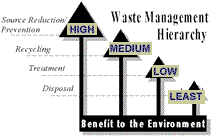
Pollution prevention became a national policy with the Pollution Prevention Act of 1990. The Act established the waste management hierarchy (right) whereby wastes should be prevented or reduced at the source whenever feasible and safe disposal is the option of last resort. |
 |

The Pollution Prevention Act of 1990
FINDINGS - The Congress finds that:
- The United States of America annually produces millions of tons of pollution and spends tens of billions of dollars per year controlling this pollution.
- There are significant opportunities for industry to reduce or prevent pollution at the source through cost-effective changes in production, operation, and raw materials use. Such changes offer industry substantial savings in reduced raw material, pollution control, and liability costs as well as help protect the environment and reduce risks to worker health and safety.
- The opportunities for source reduction are often not realized because existing regulations, and the industrial resources they require for compliance, focus upon treatment and disposal, rather than source reduction; existing regulations do not emphasize multi-media management of pollution; and businesses need information and technical assistance to overcome institutional barriers to the adoption of source reduction practices.
- Source reduction is fundamentally different and more desirable than waste management and pollution control. The Environmental Protection Agency needs to address the historical lack of attention to source reduction.
- As a first step in preventing pollution through source reduction, the Environmental Protection Agency must establish a source reduction program which collects and disseminates information, provides financial assistance to States, and implements the other activities provided for in this subtitle.
POLICY - The Congress hereby declares it to be the national policy of the United States that pollution should be prevented or reduced at the source whenever feasible; pollution that cannot be prevented should be recycled in an environmentally safe manner whenever feasible; pollution that cannot be prevented or recycled should be treated in an environmentally safe manner whenever feasible; and disposal or other release into the environment should be employed only as a last resort and should be conducted in an environmentally safe manner.
EPA Definition of Pollution Prevention
The concept of pollution prevention is broadly applicable--a tool to accomplish many environmental tasks. Pollution prevention requires a cultural change--one which encourages more anticipation and internalizing of real environmental costs by those who may generate pollution, and which requires assistance providers to build a new relationship with their constituents to find the most-effective means to achieve those goals.
The following EPA "Statement of Definition" is a formal embodiment of what has been the Agency's working definition of pollution prevention, and is consistent with the Pollution Prevention Act of 1990 and the Agency's 1991 Pollution Prevention Strategy. It makes clear that prevention is the first priority within an environmental management hierarchy that includes: 1) prevention, 2) recycling, 3) treatment, and 4) disposal or release.
Whether the pollution prevention option is selected in any given situation will depend on the requirements of applicable law, the level of risk reduction that can be achieved, and the cost-effectiveness of that option.
The hierarchy should be viewed as establishing a set of preferences, rather than an absolute judgment that prevention is always the most desirable option. The hierarchy is applied to many different kinds of circumstances that will require judgment calls.
Drawing an absolute line between prevention and recycling can be difficult.
"Prevention" includes what is commonly called "in-process recycling,"
but not "out-of-process recycling." Recycling conducted in an environmentally
sound manner shares many of the advantages of prevention, e.g. energy and resource
conservation, and reducing the need for end-of-pipe treatment or waste
containment.
As EPA looks at the "big picture" in setting strategic directions for the decade ahead, it is clear that prevention is key to solving the problems that all our media programs face, including the increasing cost of treatment and cleanup. In the common-sense words of Benjamin Franklin, "an ounce of prevention is worth a pound of cure."
EPA Statement of Definition
(pursuant to the Pollution Prevention Act of 1990 and the Pollution Prevention Strategy)
Under Section 6602(b) of the Pollution Prevention Act of 1990, Congress established a national policy that:
- pollution should be prevented or reduced at the source whenever feasible
- pollution that cannot be prevented should be recycled in an environmentally
safe manner whenever feasible - pollution that cannot be prevented or recycled should be treated in an environmentally safe manner whenever feasible
- disposal or other release into the environment should be employed only as a last resort and should be conducted in an environmentally safe manner
Pollution prevention means "source reduction," as defined under the Pollution Prevention Act, and other practices that reduce or eliminate the creation of pollutants through:
- increased efficiency in the use of raw materials, energy, water, or other resources
- protection of natural resources by conservation.
The Pollution Prevention Act defines "source reduction" to mean any practice which:
- reduces the amount of any hazardous substance, pollutant, or contaminant entering any waste stream or otherwise released into the environment (including fugitive emissions) prior to recycling, treatment, or disposal
- reduced the hazards to public health and the environment associated with the release of such substances, pollutants, or contaminants
The term includes: equipment or technology modifications, process or procedure modifications, reformulation or redesign of products, substitution of raw materials, and improvements in housekeeping, maintenance, training, or inventory control.
Under the Pollution Prevention Act, recycling, energy recover, treatment, and disposal are not included within the definition of pollution prevention. Some practices commonly described as "in-process recycling" may qualify as pollution prevention. Recycling that is conducted in an environmentally sound manner shares many of the advantages of prevention--it can reduce the need for treatment or disposal, and conserve energy and resources.
In the agricultural sector, pollution prevention approaches include:
- reducing the use of water and chemical inputs
- adoption of less environmentally harmful pesticides or cultivation of crop strains with natural resistance to pests
- protection of sensitive areas
In the energy sector, pollution prevention can reduce environmental damages from extraction, processing, transport, and combustion of fuels. Pollution prevention approaches include:
- increasing efficiency in energy use
- substituting environmentally benign fuel sources
- design changes that reduce the demand for energy